blog & news
KCNQ2 Connections
Highlights from the 2026 KCNQ2 Cure Research Roundtable
Published on October 14, 2026
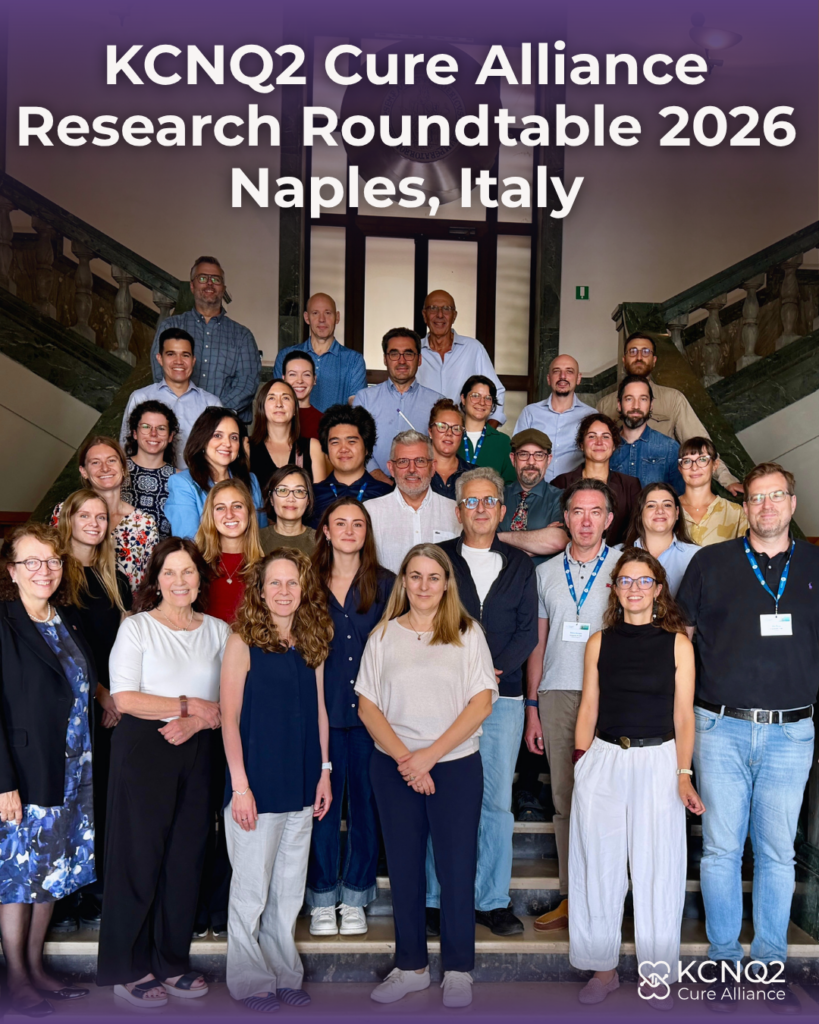
The best research isn’t done in isolation. That’s why, every year, the KCNQ2 Cure Alliance brings researchers, clinicians, industry partners, and advocates together for an annual Research Roundtable. This year we traveled to Naples, Italy, to meet with our international research network following the 3rd International Kv7 Channels Symposium.
In one packed day, experts shared where KCNQ2 research stands today and where it’s headed next. Discussions covered findings from lab models, potential therapies, clinical trials, and natural history studies. Here are some of the day’s key takeaways:
Lab models are helping explain how KCNQ2 variants affect the brain
Several teams presented work using cells or mice that carry specific KCNQ2 variants. Cell models let researchers examine how specific variants alter biology, while mouse models show how those changes affect the brain and, ultimately, behavior. Together, they help explain how a single genetic change can cascade into larger disruptions in brain biology, which in turn cause the symptoms people experience.
These models are being used to test potential treatments
Other groups shared early results from testing new, experimental therapies in these lab models. Approaches discussed included gene therapies that use modified viruses (called AAVs) and antisense oligonucleotides (ASOs) to precisely dial KCNQ2 expression up or down in the brain. Because these therapies are being tested in models that carry the same variants seen in people, researchers are also working to identify which individuals may benefit most from each approach.
Treatments for KCNQ2-related disorders are reaching people
Small molecule medicines. Small molecules are what most people think of as traditional drugs. QurAlis shared that they’re in the process of developing a clinical trial plan for testing QRL-101 in people with KCNQ2-related disorders. This drug activates the potassium channel that is affected by KCNQ2 variants, so it has potential to be helpful in our community; we will share more details as their plan gets finalized.
Personalized ASOs. We heard an update on the first person with KCNQ2-DEE to receive a personalized ASO developed through the n-Lorem Foundation. For this trial, the ASO was custom-designed for one individual. Whether it could help others depends on how their variant affects channel biology and other genetic factors the ASO relies on to find its target. The KCNQ2 Cure Alliance intends to work closely with those involved in the ASO development and delivery to understand how we advance this approach in additional patients.
Natural history studies are helping us better understand KCNQ2-related disorders
Natural history studies are built to capture multiple features of disease expression and how disease symptoms change over time. Natural history studies can better inform clinical care and can serve as a way to measure the benefits of a new therapeutic. Speakers shared updates from their natural history studies and discussed the benefits of having robust participation across the community.
Research registries are also used to help build an understanding of KCNQ2-related disorders
Registries complement natural history studies by collecting broad information from families, clinicians, or both, creating a shared resource that researchers, clinicians, and drug developers can draw on. One KCNQ2-specific registry is already open, and two more are in development. Our goal isn’t simply more registries, but making sure they can work together: sharing data where governance and privacy protections allow, avoiding duplicated effort, and making the most of the information families have already contributed. With so few people affected, this kind of collaboration is essential to building the most complete picture of KCNQ2-related disorders.
We’re working to create resources that highlight active and collaborative Natural History initiatives and research registries. Stay tuned for future communications and webinar content.
It was a great day full of learning from major contributors to KCNQ2-related research and hearing where our community can make the biggest difference next. We’ll continue these conversations at our 2027 Research Roundtable, held on the first day of the 2027 KCNQ2 Family & Research Summit in Bloomington, MN, June 23–25th. We hope you’ll join us to hear about these efforts and more!