Q2 Quick Notes
Q2 Quick Notes
Q2 Quick Note #12: Functionality Dictates Potassium Channel Location
Published on March 16, 2026
 Excerpt
Researchers found that Kv7 channels that do not function properly may also fail to reach their correct location in neurons.
What It’s About
By zooming in and looking at how single molecules interact within cells, researchers studied how variants in the KCNQ3 gene affect the localization of Kv7 channels in neurons.
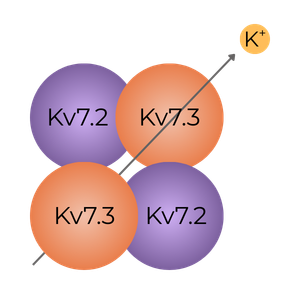
Kv7 channels are formed when four proteins assemble together, most commonly two Kv7.2 proteins (made from KCNQ2 gene) and two Kv7.3 proteins (made from KCNQ3). Once assembled, these channels are moved to a specific location on the surface of neurons where they help move potassium ions out of the cell (see picture).
When researchers introduced mutations into KCNQ3 in cultured neurons, they found that a key trafficking pathway was disrupted. As a result, Kv7 channels containing mutated Kv7.3 proteins failed to reach their correct location.
Why It Matters
This study shows that variants that impair Kv7 channel function can also prevent the channels from getting to where they are needed in neurons. Because variants in KCNQ2 can also disrupt Kv7 channel activity, these findings suggest that some disease-causing variants may affect both channel function and location. In fact, this type of misplacement has already been seen in a mouse model of KCNQ2-DEE (covered in a previous Quick Note). Understanding how and when this happens will be an important direction for future research.
The Quick Term
Trafficking: Proteins are made in specific parts of a cell, then trafficked (moved) to their final destination to perform their function.
Link
Summary prepared by Michelle Kielhold, PhD., Scientific Communications Intern at KCNQ2 Cure Alliance. Content is intended for informational purposes and does not replace medical advice.