Codes Approved!
ICD-10 Codes
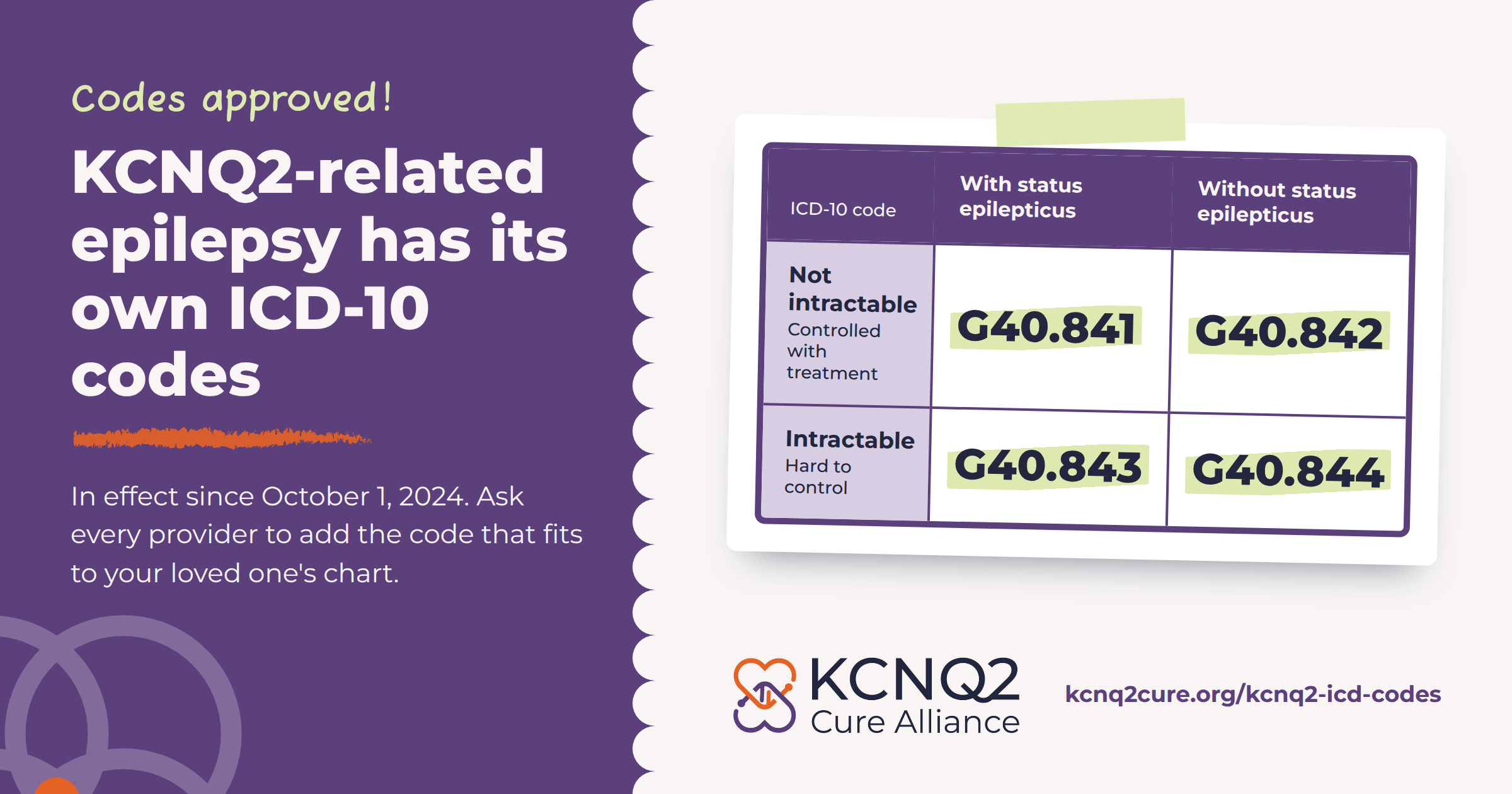
Four diagnosis codes, just for KCNQ2-related epilepsy. Here is what they mean and how to get them on your loved one's chart.
What is an ICD-10 code?
Developed by the World Health Organization (WHO), the ICD-10 is the tenth version of the International Classification of Diseases. Doctors, hospitals, insurance companies, and health organizations around the world use it to classify every diagnosis, symptom, and procedure.
Each code is unique and carries specific information about one condition. KCNQ2-related epilepsy now has four of its own: G40.841 through G40.844.
Why these codes matter

Better recognition
Medical records show the actual KCNQ2 diagnosis instead of a broader epilepsy category, so providers and insurers see the condition clearly.

Easier access to care
Insurers often require an ICD-10 code to approve treatment. A specific code means fewer barriers to the care and therapies your loved one needs.

Stronger research
Researchers can track KCNQ2-related epilepsy more accurately, which helps map the full spectrum of the disorder and moves us toward better treatments and a cure.

More awareness
Specific codes make KCNQ2 visible to the medical community and policymakers, which can bring more research funding and support for our community.
Find Your Code
The four codes
Each code answers two questions: can seizures be controlled with treatment, and has your loved one had status epilepticus?
G40.841
KCNQ2-related epilepsy, not intractable, with status epilepticus
Seizures can be controlled with treatment, but your loved one has had status epilepticus.
G40.842
KCNQ2-related epilepsy, not intractable, without status epilepticus
Seizures can be controlled with treatment, and there has been no status epilepticus.
G40.843
KCNQ2-related epilepsy, intractable, with status epilepticus
Seizures are difficult or impossible to control with treatment, and your loved one has had status epilepticus.
G40.844
KCNQ2-related epilepsy, intractable, without status epilepticus
Seizures are difficult to control with treatment, and there has been no status epilepticus.
What do these terms mean?
Not intractable
Epilepsy that can be controlled with treatment, such as medicines or other therapies. It is not cured, but it can be managed.
Intractable
Epilepsy that stays hard to control despite treatment. It is considered intractable (drug-resistant) when seizures continue after at least two appropriate medicines have been tried.
Status epilepticus
A seizure that lasts longer than five minutes, or seizures that follow one another without the person regaining consciousness in between. It needs urgent medical care.
Bring This to Every Visit
What can I do?
Share these codes with every member of your loved one's care team. Ask each doctor, therapist, and hospital to add the code that fits to medical records and insurance claims.
- G40.841
- G40.842
- G40.843
- G40.844