Newly Diagnosed
I could never have known on that diagnosis day that what seemed like a lonely time would become a wonderful world of people who love our child just as much as much as we do.
– Marilyn Maloney
Newly Diagnosed
I could never have known on that diagnosis day that what seemed like a lonely time would become a wonderful world of people who love our child just as much as much as we do. – Marilyn Maloney
We know that a KCNQ2 diagnosis can be overwhelming.
You may be confused, scared, frustrated, or uncertain—and your emotions may change from day to day, sometimes even hour to hour.
As parents of children with KCNQ2, we know what it's like to feel overwhelmed and isolated – especially in the days and weeks after your child's diagnosis. But we're here to tell you there is HOPE.
You are not alone. You are now part of KCNQ2 Cure: a network of families, researchers, clinicians, and other professionals who are determined to make a difference. Our community of families and experts are available to help you navigate your journey.
KCNQ2 is a very rare disease, first identified in 2012. As a result, your doctor may not be familiar with KCNQ2, and you may need to take the lead in learning more about your child’s condition from our KCNQ2 community.
KCNQ2 affects many aspects of a patient’s life, so we encourage you to take a comprehensive approach; making sure your child is on the best medications for the treatment of seizures or other symptoms, being sure to engage with all of the specialists who may be helpful – from geneticists to neurologists, to gastroenterologists, evaluating potential vision or hearing issues, and engaging therapists to address physical, cognitive and speech issues as early as possible.
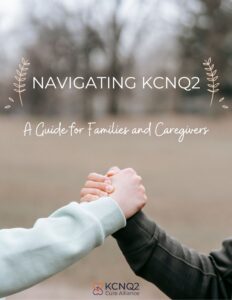
Navigating KCNQ2:
A Guide for Parents
and Caregivers
Our Recommendations/Checklist
Our families have created a list of recommendations for newer families. These are a good starting point for learning more about KCNQ2-related disorders and resources.
Genetic Report
Request and keep a copy of your child's genetic report. As science advances and research opportunities arise having a copy of the report which lists your child's sequence variant will be instrumental.
Support groups
Connect with other families through our KCNQ2 global caregiver group. KCNQ2 Cure hosts a global caregiver support group, allowing you to connect with families in your area and around the world. In addition to joining the KCNQ2 community, connecting with others in your country, state, or region will give you access to people familiar with local resources.
Contact Registry
Add your information to the KCNQ2 Cure contact registry. The purpose of this registry is to make sure we have the most current contact and demographic data for individuals with KCNQ2 developmental and epileptic encephalopathy and their families in order to keep them updated on the latest research, clinical trials, and KCNQ2 news.
Frequently Asked Questions
Review our list of frequently asked questions here.
Create a Seizure Diary
Creating an online seizure diary through the Epilepsy Foundation is a helpful way to track and report seizure data for those who need it.
Seizure Action Plan
Develop a written plan regarding what actions to take in the event of a seizure, with the help of the Seizure Action Plan from the Epilepsy Foundation.
Informational Videos
Watch videos from past KCNQ2 Cure Summits and informational webinars, which will provide you with the latest research, understanding of KCNQ2, and resources.
Caregiver Notebook
Download and fill out the Child Neurology Foundation's respite care notebook for any time you may need to leave your child in another person’s care, so that they have all of the important information needed to care for your child in your absence.
Rescue Medications
Understand all medications and proper use of rescue drugs, ensuring you have plenty on hand.
Understand SUDEP
Understand the risk of SUDEP (ask your epileptologist about whether a monitor could be useful).
Medicaid Waiver (US only)
In the United States, it is possible to apply for a Home & Community-Based Waiver (HCBW), TEFRA, or Katie Beckett Waiver. The HCBW is a federal waiver that is intended for children up to eighteen years of age with a qualifying chronic disability. This program entitles children to Medicaid coverage who would not otherwise qualify due to their family’s financial status (children may qualify independent of family income). This program is administered on a state-by-state basis and varies greatly depending on the state. However, most states have a waiting list, so it is helpful to sign up as soon as possible. The HCBW can be obtained by contacting your local Department of Family & Children Services. Other families in the KCNQ2 Cure family support group may be able to offer helpful suggestions about applying in your state. More information is also available at http://www.kidswaivers.org/