Start Your Research Journey
A starting point for understanding KCNQ2 research, current approaches, and where to begin.
Start Your Research Journey
A starting point for understanding KCNQ2 research, current approaches, and where to begin.
Where to Begin?
Every data point is a piece of HOPE.
Together, our shared information fuels discoveries, guides treatments, and brings us closer to cures.
When families, clinicians, and researchers unite to share knowledge, we turn individual experiences into powerful insights that drive change. Each contribution—no matter how small—helps illuminate the path forward for every child and family affected by KCNQ2.
By participating in research and sharing your story, you become a catalyst for progress, transforming hope into action and data into discovery.
Your first step in participating in research and studies should be to create a CRID identifier (Clinical Research ID). Think of the CRID as your passport in the research world. It allows your data to “travel” safely between studies, hospitals, and scientists, enabling collaboration while protecting your identity. Patients can share their CRID identifier with investigators on research studies that support the CRID they are participating in. By sharing your CRID (KCNQ2 Research ID), researchers can then reuse, merge, and share your research data without using your personal identifiable information. This helps create a dataset for an individual vs. a variant. For more information, you can read this recent publication.
To create your CRID today, visit https://thecrid.org. You can watch the video below to see how quick it really is. It takes 2 minutes!
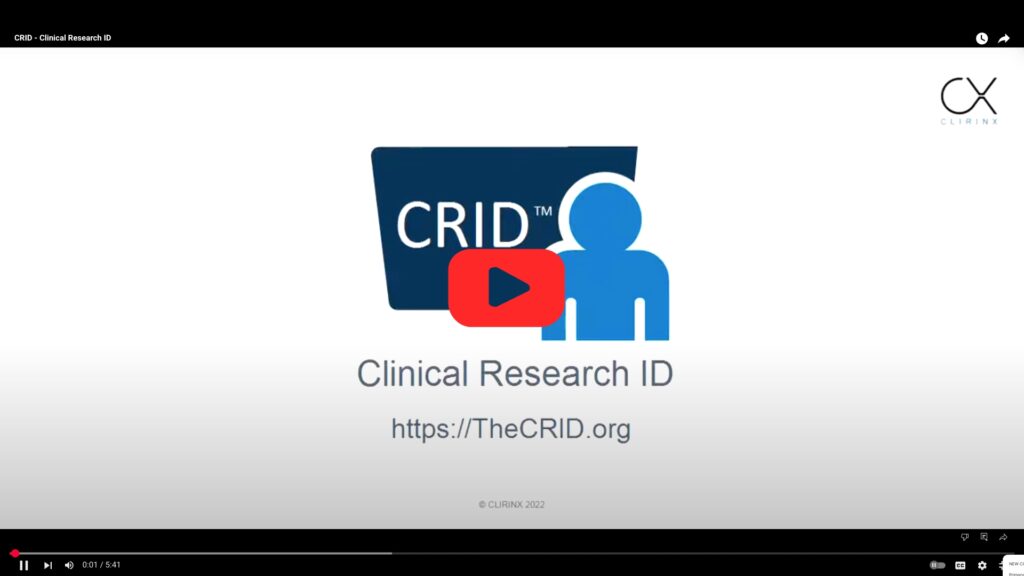
Introduction to the Clinical Research ID
Clinical trials are research studies that test new treatments to determine if they are safe, effective, and appropriately dosed. In the United States, the Food and Drug Administration (FDA) reviews clinical trial data before approving a drug for public use.
Why Clinical Trials Matter
Clinical trials are essential for advancing medical knowledge and improving patient care. For rare conditions like KCNQ2-related disorders, clinical trials help determine whether potential treatments are safe and effective for our community.
Who Can Participate
Each clinical trial has specific eligibility criteria, such as age, diagnosis, medical history, or prior treatments. These guidelines ensure that the study results are accurate and that participants are kept safe.
What to Expect
If you take part in a clinical trial, your care team—doctors, nurses, and other health professionals—will closely monitor your health. You may have more medical visits and tests than usual, and you may sometimes need to travel to a study site.
Benefits and Risks
Participating in a clinical trial may offer early access to promising new therapies and provide expert medical attention. Even if you don’t personally benefit, your participation helps advance research for others affected by KCNQ2.
However, new treatments may not always be better than standard care, and unknown side effects can occur. Some costs related to participation—like travel or certain medical expenses—may not be fully covered by insurance, so it’s important to check with your healthcare provider and insurer beforehand.
Off-Label Use
Sometimes, approved drugs are prescribed for uses not listed on their FDA label—this is called off-label use. It is legal and common in rare disease treatment, but it may not always be covered by insurance. Patients and families should work with their doctors to understand potential benefits, risks, and costs before pursuing off-label treatments.
You Can Read More About Clinical Trials Here.
Observational studies do not test treatments. Instead, they collect data that helps researchers understand how KCNQ2-related conditions develop and change over time.
Main types include:
-
Patient Registries: Secure databases where individuals or caregivers share information about symptoms, treatments, and experiences.
-
Natural History Studies/Longitudinal Studies: Long-term projects that follow participants over time to see how symptoms progress.
Example: KCNQ2 Natural History Study at Boston Children's and Citizen Health -
Trial-Readiness Studies: Designed to identify what outcomes are most meaningful to families and how best to measure them.
Example: Current research on KCNQ2-DEE outcome measures presented at ISPOR Europe 2024.
Why it matters: These studies make sure future treatments focus on what truly impacts families’ lives.
Some projects focus on tools and technologies that help families and researchers collect, organize, and share valuable data.
Examples include:
-
Citizen Health Platform: Securely stores medical records and videos for approved KCNQ2 studies.
-
Seizure Tracker App: Helps track seizures, sleep, and wellness for easier reporting to care teams.
These supporting studies strengthen the entire research ecosystem, turning family experiences into progress for future treatments.
Observational studies do not test treatments. Instead, they collect data that helps researchers understand how KCNQ2-related disorders develop and change over time.
Once scientists have enough data from early and observational work, they begin testing potential treatments. These studies explore whether a therapy, device, or behavioral approach is safe and effective.
Examples of KCNQ2-focused studies:
-
XEN496 Clinical Trial — a pediatric formulation of ezogabine developed to treat KCNQ2-DEE (Xenon Pharma).
-
Personalized “N = 1” Studies — highly individualized treatment programs for unique KCNQ2 variants, using precision genetic approaches.
What to expect: Participants may receive the new treatment, a comparison therapy, or a placebo. Every trial follows strict safety rules and informed-consent procedures.
- Your Rights and Protections: Participation is always voluntary. You can withdraw at any time. Privacy and data security are protected through strict protocols.
-
Informed Consent: Before joining any study, you’ll receive full details about the purpose, risks, and what will be asked of you.
-
Making the Choice: Learn about study types, talk with your care team, and decide if and when participation feels right for your family.
Learn more about current opportunities at kcnq2cure.org/research.
Research Activites Currently Recruiting

Citizen Health
Digital Natural History Study- Citizen Health is a KCNQ2 digital natural history study that uses medical records to collect meaningful information on how a mutation in the KCNQ2 gene has affected a person’s life, and it includes medical record information across multiple hospitals and providers where a participant has been seen.
What is involved: One-time form to complete
Language: English
Who can participate: Anyone whose medical records are in English.
- For US families the document upload is automated.
- For those outside of the US with records in English, you will have to upload your documents manually.
How to participate: Enroll online at Citizen Health

KCNQ2 Portal and Phenotype
Observational Study: Clinical records often lack the depth needed to capture the full experience of neurodevelopmental disorders. By sharing your daily observations, you’ll help create a valuable dataset that highlights the nuanced, age-specific features of KCNQ2-related disorders, setting the stage for improvements in diagnosis and treatment.
What is involved: A 10-minute virtual consent; a 20-minute online survey; an optional virtual interview
Language: English
Who Can Participate: Any English speakers
How to Participate: Complete THIS FORM to participate
Observational Studies
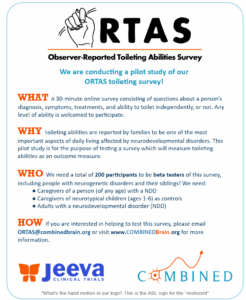 Observer Reported Toileting Abilities Survey (ORTAS) Validation Study
What: Toileting abilities are reported by families to be one of the most important aspects of daily living affected by neurodevelopmental disorders. This pilot study is for the purpose of testing a survey that will measure toileting abilities as an outcome measure.
What is involved: a 30-minute online survey consisting of questions about a person’s diagnosis, symptoms, treatments, and ability to toilet independently, or not. Any level of ability is welcome to participate.
Who Can Participate:
- Caregivers of a person (of any age) with a neurodevelopmental disorder (NDD)
- Caregivers of neurotypical children (ages 1-6) as controls
- Adults with a neurodevelopmental disorder (NDD)
How to Participate: email ORTAS@combinedbrain.org or visit www.combinedbrain.org for more information.
 KCNQ2 Speech and Feeding Study
What: An international project to examine speech, language, and feeding outcomes in individuals with KCNQ2 DEE. By improving our understanding of communication and feeding in KCNQ2, we hope to improve prognosis, better identify those who need support, and develop more targeted speech therapy practices.
What is involved: 1-hr virtual speech & feeding assessment; 2.5-hr online surveys
Language: English, French, German, Spanish, and Dutch
Who Can Participate: Those 6-months to adult with KCNQ2-DEE
How to Participate: Complete THIS FORM to show your interest.
Clinical Trials and Interventional Research Opportunities
The EMERALD Study
Praxis Precision Medicines
Phase: Phase 3 - Currently enrolling
Study medication: Reltrigine (Prax-562)
Type: Small Molecule
Who: For individuals with Developmental and Epileptic Encephalopathies (DEE)
Age: 2 through 65 years old
DEEp OCEAN Study
Lundbeck Pharmaceuticals
Phase: Phase 3 - Currently enrolling
Study medication: Bexicaserin (LP352)
Type: Small Molecule
Who: For individuals with Developmental and Epileptic Encephalopathies (DEE)
Age: 2 through 65 years old
LGS Discover Study
SK LifeScience Inc.
Phase: Phase 3 - Currently enrolling
Study medication: Carisbamte
Type: Small Molecule
Who: For individuals with a Lennox-Gastaut Syndrome diagnosis
Age: 4 through 55 years old
STARS Study
UCB / Parexel
Phase: Phase 3 - Currently enrolling
Study medication: Staccati Akorazikan (EP0162)
Type: Small Molecule
Who: For individuals with prolonged seizures lasting more than 3 minutes
Age: 12 years of age or older
X-TOLE2/X-TOLE3 Studies
Xenon Pharmaceuticals Inc
Phase: Phase 3 - Currently enrolling
Study medication: Azetukalner (XEN 1101)
Type: Small Molecule
Who: Adults with focal-onset seizures (FOS) or primary generalized tonic-clonic seizures (PGTCS)
Age: 18 years of age or older
X-ACKT Study
Xenon Pharmaceuticals Inc
Phase: Phase 3 - Currently enrolling
Study medication: Azetukalner (XEN 1101)
Type: Small Molecule
Who: Have experienced primary generalized tonic-clonic seizures (PGTCS) for at least 1 year
Age: 12 years of age or older
RISE
Biohaven Pharmaceuticals
Phase: Phase 2/3 - Currently enrolling
Study medication: BHV-7000
Type: Small Molecule
Who: Focal Onset Epilepsy
Age: 18 years to 75