Q2 Quick Notes
Q2 Quick Notes
Q2 Quick Note #18: Study Characterizes 30 Individuals With KCNQ2-Related Disorders
Published on July 6, 2026
Excerpt
Researchers reviewed medical records of 30 individuals with KCNQ2 variants, looking for patterns in their seizures, development, and genotypes.
What It’s About
Most people in this study had their first seizure within the first week of life, usually a focal tonic seizure. The majority eventually reached seizure control, and the sodium channel blocker oxcarbazepine was the antiseizure medication used most often in this group.
Early EEG abnormalities were common, and the 3 infants with burst-suppression patterns also had severe developmental impairments, lining up with what we covered in a previous Quick Note.
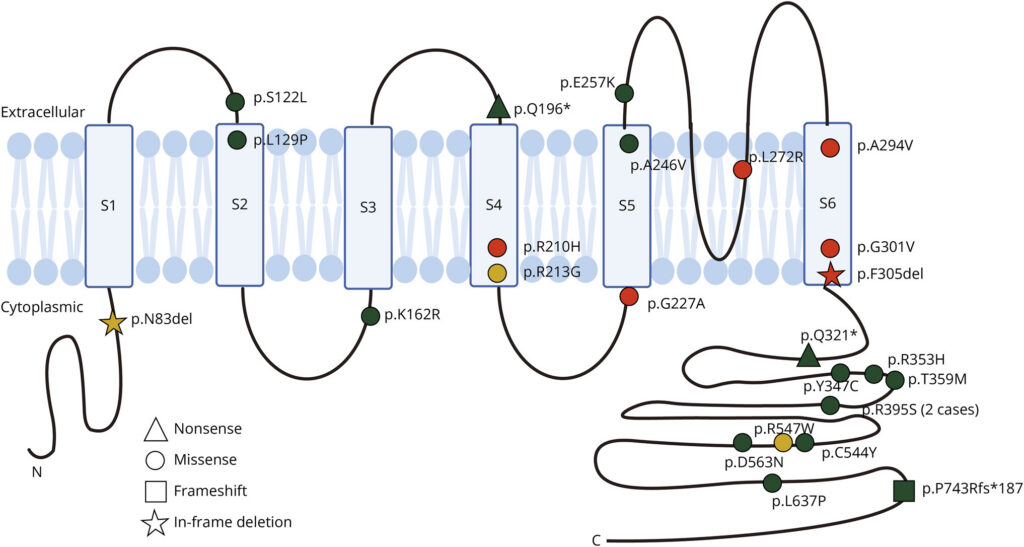
There were 29 distinct KCNQ2 variants represented in this study, most of which were missense variants. Variants affecting the S5 and S6 regions of the Kv7.2 protein tended to be associated with more severe developmental delay, while people with typical development more often had inherited variants in the C-terminal region.
You can see this pattern in the figure from the article below. It maps each person’s variant onto the Kv7.2 protein. Shapes indicate the variant type, and color indicates how severe the developmental impairment was (green = typical development, yellow = mild delay, red = significant delay).
Why It Matters
These findings suggest a few emerging patterns worth more investigation:
- Early EEG, especially burst-suppression, may help flag which infants face a higher risk of developmental challenges
- Most individuals with KCNQ2-related disorders reached seizure control, often on a sodium channel blocker, but since seizures can self-resolve, more research is needed to know the medication’s actual role in this.
In some cases, variant location may help identify who is more likely to experience severe outcomes
Quick Term
Missense variant: A small change in the genetic code that causes one building block of a protein (an amino acid) to be swapped for another. The resulting protein is usually still made, but the amino acid swap changes how well it works.
Link
Read Article
Summary prepared by science interns supervised by Michelle Kielhold, PhD., Science Program Manager at KCNQ2 Cure Alliance. Content is intended for informational purposes and does not replace medical advice.